Twins in the Royal House
Posted on January 12, 2011 Leave a Comment
This week, Denmark’s CP (Crown Princess) Mary gave birth to twins bringing the tally of royal children up to four. So far no pictures have been released yet but rumors have it that Mary is getting “royal treatment” for being allowed to stay in the hospital for five days. I guess this is unheard of due to lack of space and resources in the hospitals. The other news stories related to the event are the fact that Mary’s sister from Tasmania is “secretly” visiting and Prince Henrik, the current queen’s husband, said the twins were ugly. Well, actually he said, “they are very sweet but won’t say they are beautiful!”.
Here’s the AP Story
Denmark’s princess gives birth to twins
(AP) – 4 days ago
COPENHAGEN, Denmark (AP) — Denmark’s Crown Princess Mary has given birth to twins — a boy and a girl — the royal court announced Saturday.
The palace said Mary has become the proud mother of “two fine children” at the national Rigshospitalet hospital in Copenhagen. “Both mother and children are doing well,” the court said.
The boy, weighing 5 pounds, 14 ounces (2.7 kilograms) was the first one born Saturday morning, while his sister, weighing 5 pounds, 10 ounces (2.6 kilograms), was delivered 26 minutes later.
The 38-year-old princess was admitted to hospital early Saturday morning, accompanied by her husband Crown Prince Frederik, who was present during the whole labor.
“It’s a miracle,” the smiling father told Danish broadcaster TV2 and other media at the hospital. “It’s two small hearts to keep an eye on.”
Tasmanian-born Mary married the Danish prince in 2004. The couple already have two children, 5-year-old Christian and 3-year-old Isabella.
The Danish Christmas Lunch
Posted on November 16, 2010 Leave a Comment
In light of the fact that it’s soon time again to endulge in the traditional Danish Christmas lunch or “julefrokost,” I am posting an article I wrote a couple years ago about working your way around the infamous Danish open-faced sandwiches and the all too familiar Christmas lunch. And if you are on the hunt for a place to try these infamous sandwiches, visit my favorite of them all — The Royal Cafe’ for some xmas-themed smushies, and while there, be sure to visit the annual table decorations at the Royal Copenhagen shop!

The Art of the Danish Lunch
Copenhagen Exclusive Magazine

November 2007
By Laura Stadler-Jensen
The Christmas season marks the time for the Julefrokost or Christmas lunch. But this is no ordinary lunch. It’s art — where the rye bread is the canvas and the toppings are morsels of mouth watering delicacies designed to delight the eyes as well as the pallet.
Christmas is by far the very best time to experience one of the most traditional types of Danish cuisine in all its shapes and forms. The open-faced sandwich, or smørrebrød (meaning “butter and bread”), is a long standing Danish tradition that can be sampled any time of year. However, starting mid November through Christmas, the ordinary Danish lunch is turned into the Christmas lunch. A plethora of dishes are prepared in an ensemble meant to be enjoyed from start to finish.
But, before you jump in, it’s good to know some of the rules. It’s not just a sandwich after all. Don’t worry, I’ve lived in Copenhagen for just over five years and still don’t know all the rules! I can recall having my first typical Danish lunch with my Danish family. They began by putting out small plates of fish, meatballs, sliced meats, salads, pâté and cheeses along with a basket full of several kinds of fresh sliced breads. I thought, wow, now this is a lunch! I am an American and like to have a lot of options, but this was a bit over the top.
One thing that all open-faced sandwiches have in common is their foundation. Most are made with thin slices of Danish rugbrød, hearty dark rye bread made mostly of whole grains. Some are made with slices of white or sour dough bread but all are usually decked with layers of ingredients and then topped with dainty garnishes that playfully add to the texture and taste. When sampling Danish open-sandwiches, it is customary to choose between two to three for a lunch meal. You can also just start with one and add them on as you go because they can be quite heavy and filling.
One of the most traditional types to start with is herring, which can be pickled, marinated, boiled or even fried. The texture may be difficult to get used to at first bite, but if you decide to taste herring for the first time, the curry herring is one of the most favored. I will admit that I was reluctant to try herring myself. It took several tries before I started to acquire a taste for it. I never thought I’d actually come to like it, but I do and prefer the curried herring the most.
Be sure to complement herring with ice cold snaps. It helps the fish make its way down the hatch and clear the taste buds for the next course. Unlike other digestives, Danish aquavit accompanies the entire meal, but at 40-45 percent alcohol levels it’s wise to use caution. In between the snaps, beer is the most compatible, preferably one of the many seasonal Christmas brews usually available on tap. Danish aquavit goes hand in hand with open-faced sandwiches, and especially the Christmas lunch.
Julefrokost, as it’s called, is not only a meal but a celebration in Denmark. Many associate Julefrokost with company Christmas parties, as well as Christmas celebrations with family and friends. It’s an all evening affair that usually lasts until the early morning hours. As a result, you can be hard pressed to find a taxi most Friday nights in December in central Copenhagen.
I can remember my first Julefrokost vividly, or should I say I sort of remember. All I know is that the meal started at 6 p.m. and by 6:30 p.m. it went from 0 to 100 miles per hour with food being passed around and people shouting across the table and saying skål or “cheers” just about every five minutes. And there was no declining participation either. I can recall looking at my watch and thinking, this must be a record for the shortest time it took me to get completely intoxicated in my life.
So, what makes the traditional Christmas lunch different from the Danish lunch? The main difference is that smørrebrød is individual sandwiches from an á la carte menu and Julefrokost (Christmas lunch), which can also be called “Julebordet” (the Christmas table), is a variety dishes served family-style like a smorgasbord at the table. Each dish has plentiful portions for arranging on your own plate. Many classic open-faced sandwich fixings are included with the addition of Christmas dishes such as æbleflæsk (boiled apples with bacon), flæskesteg (pork roast) served with pickled red cabbage and Jule sylte, a type of pork terrine served with pickled red beats and mustard. For an á la carte Christmas lunch, these added seasonal dishes are available for single portion sandwich options at most smørrebrød restaurants.
When ordering the full Christmas lunch, you are usually presented with multiple plates and cutlery, which can be daunting at first. As a general rule, here are some helpful hints. The first courses are always fish, starting with herring and moving on to salmon then fried plaice and shrimp. Next are warm dishes requiring a clean plate and cutlery, then cold cuts or pålæg, and salads such as chicken or egg salad. Finally, a third plate is used for cheese and fruit, finished by coffee and chocolates, kransekage (marzipan cake), or risalamande with kirsebærsauce (rice pudding with cherry sauce). When in doubt, you can always ask your waiter for guidance.
Sampling Smørrebrød
Perhaps the most famous place to try smørrebrød is Ida Davidsen located just off Kongens Nytorv (King’s New Square). Five generations of Davidsen’s have served up Danish open-faces sandwiches and the restaurant has more than 250 different kinds on the menu. With so many to choose from, you can easily find yourself lost in the long list of variations from crayfish tails to ox tongue to gorgonzola with egg yolk.
One of the most traditional is Restaurant Sankt Annæ, dating back to 1897 located near the Royal Palace. You may even be lucky enough to spot a member of the Royal family among the clientele. Voted the year’s best lunch restaurant for 2007, Restaurant Sankt Annæ prides itself on preparing home-made ingredients including its own pickled condiments such as pickled cucumber salad, pumpkin, and red beets. The quaint and charming restaurant offers a wide variety of classic open-faced sandwiches that are served on Royal Copenhagen porcelain.
While Danish smørrebrød is traditional, there is some innovation taking place with something new called “smushi,” an invention taking smørrebrød and creating sushi-ish size portions that are sculpted into true pieces of art. The new twist on the tradition is offered at The Royal Cafe located between the Royal Copenhagen and Georg Jensen shops on the main shopping street. “The idea with smushi is to create smaller portions so one can sample more varieties and really get a taste of Denmark,” said owner Rud Christiansen.
Christiansen and his partner and interior stylist Lo Østergaard have custom designed the café from floor to ceiling with designs from Holmegaard, Royal Copenhagen, Bang & Olufsen and Arne Jacobsen, just to name a few. Part Danish design museum, part shop and café, “the funny, funky, baroque, rock and roll-style café is a showcase for promoting Danish society and food,” Christiansen said.
The new smushi and Danish café concept is so popular that franchises in Singapore, Seoul, Taipei and Tokyo are set to open next year. Christiansen also talked of looking for space in the U.S. In addition, smushi-making has been added to the official smørrebrød curriculum at Copenhagen’s culinary school. It will be taught as somewhat of an art form, like making sushi is, where there is an architectural approach to the design and assembly.
After trying smushi myself, I can honestly say that it was some of the most beautiful food I have ever seen or eaten. It was so meticulously perfect and precisely decorated that I didn’t want to destroy it with my knife and fork. It also tasted as good as it looked. The best part is that it did actually preserve the tastes and texture of the original smørrebrød that it was modeled after.
There is nothing quite as traditional as smørrebrød or the Christmas lunch when it comes to cultural cuisine in Denmark. If you have the opportunity, it is worth sampling. No matter if it’s a few smushi in the eclectic Royal Cafe, or the entire Julebordet, everyone is sure to find something they like. If not for the taste then for the artistry and craftsmanship that goes into making them, and for the pure fun of it!
Laura Stadler-JensenCulture & Travel
www.mph-communications.com www.danishfashioninstitute.dk www.copenhagenfashionweek.dk www.woco.dk–>
Vegetarian Cafes/Restauants in CPH
Posted on November 9, 2010 5 Comments
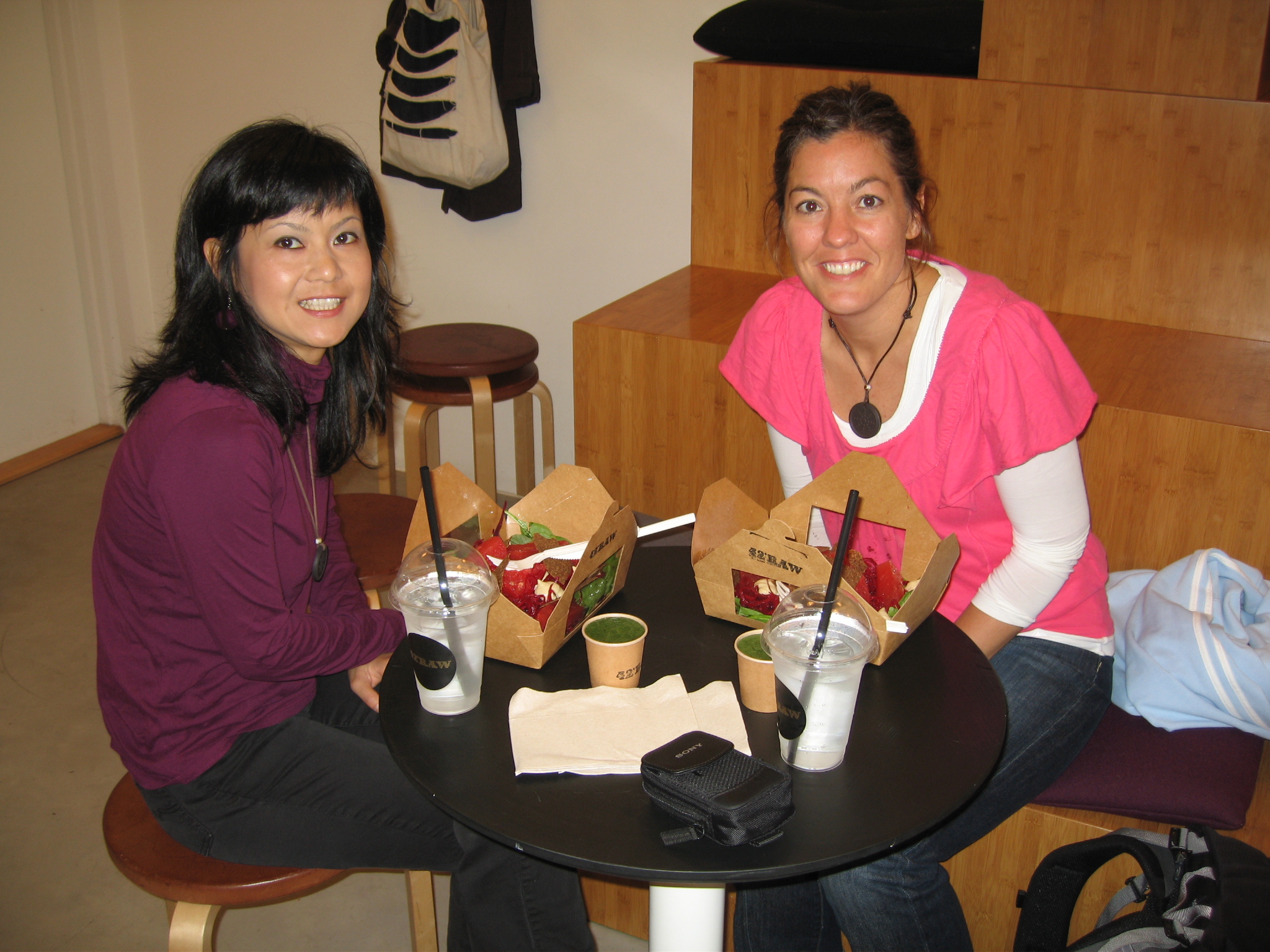
Me (on the right), a good friend Akiko (left), and my husband Lasse (behind the camera) eating lunch at 42 Raw.
I often find myself wondering where to find good vegetarian food in Copenhagen either for a quick inexpensive lunch or for dinner perhaps with a little more sophistication. So I decided to start a list of my own and add to it when I find good places that fit the bill. Here are some of my favorites, and some others that I’ve heard about but have not tried yet. If you read this and know of some yourself, please let me know!
Souponatural — This small cozy basement cafe is in the Latin Quarter and serves organic soup. It is also a cocktail bar. The place is very hip and intimate, and has free wi-fi so it’s perfect for lunch on your own or just to go and hang out and work. Their slogan is, “Don’t panic, it’s organic.” AND the service is great.
Atlas Bar — Also located in the Latin Quarter just around the corner from Souponatural is another basement cafe that has exceptionally good “mindfully prepared” vegetarian food. They also have meat dishes however their fresh salads and warm veg dishes are excellent. You can also go for a salad plate, which is a combination of several kinds of salads or just a juice — they make fresh pressed veggie and fruit juices. You can even make a special request if you are craving something special like beetroot and orange, for example. Upstairs is Flyfisken, which should also be good (it was included in the Fodor’s guide I worked on), but I have not tried it myself.
42 Raw — Located in Pilestræde in the center of the city near Kongens Nyrtorv is one of the first, if not The first, raw food bar in CPH. It’s a small place with stadium-like bench seating (not the most comfortable but perfect for “picnic-like” dining). Their main offers are salads (go figure, it’s raw :), but they also have soups and desserts which should be good. Overall the food is super fresh and it does give you a real energy boost but for me the prices are a tad too high. They also have a lot of fresh juice offerings including juice shots.
The Raw Tribe — This is another raw food place but it’s located in Nørrebro on Blagardsgade . I have not tried this place but it looks quite similar to 42 Raw. They offer raw pizza, veggie boxes and juices as well as raw cakes.
Crazy Chicken — While this place does offer rotisserie chicken, it has a wide variety of Turkish-style salads like lentil, broccoli or humus at very good prices. Located near the lakes in Østerbro.
Picnic — Located just off of Sankt Hans Torv, this little, very casual and inexpensive cafe like many others offers a variety of Turkish-style salads and warm dishes.
Morgenstedet — Located in Christiania is a real hippie-style vegetarian place. The food reminds me of the food I had on the 10-day Vipassana meditation course I went to — food made from the heart with good intension. The place normally offers a warm dish of the day and a variety of salads with fresh bread. They have a small indoor seating area and picnic tables outside.
BioM — Denmark’s first and only (as far as I know) government certified 100 percent organic restaurant — even the paint on the walls is organic. Two former royal guards and chefs for the Royal family (I believe) teamed up and created this lovely restaurant not far from Christiansborg Castle. It’s not all vegetarian, but it is all organic and they do a fabulous job. They take a lot of inspiration from Provence as well and their brunch is amazing. I highly recommend this place for semi-fine dining.
BioMio — Located in the meat-packing district — one of the new “hip” places over there. The place advertises having organic healthy food options at good prices. Their menu features a series of codes for meals that are low-fat, low carb and low cal, as well as items offering specific health benefits like dishes that have certain vitamins or give effects like energy booster, brain booster, macho, after-shopping relief, ect. They have a variety of wok, curry, and brunch options as well as salads. I have heard mixed reviews on the place and since I haven’t tried it myself, I can’t say much more!
Restaurant Saison — Another option for serious fine vegetarian dining is Saison (or “seasons), a restaurant that’s part of Hellerup’s Park Hotel restaurant run by the highly acclaimed chef Erwin Lauterbach, known for his many contributions to the culinary world and not least his exquisite treatment and ode to the vegetable in his French-Danish inspired dishes. I am dying to try the vegetarian dinner menu at some point.
I can’t mention vegetarian without adding a couple Indian restaurants…so here are two of my favorites:
Deep Restaurant — Located on Vesterbrogade (no. 89), this is one of the most authentic Indian restaurants in the city as far as I’m told. It’s family owned and offers a simple classic buffet with veg option, and a la carte options. You literally feel like you are stepping into India when you are there. It’s authentic, tasty, cozy and inexpensive.
Spicy Kitchen — Right near Christianshavn torv is the Spicy Kitchen — they recently redid their facade, which used to read Spicey Kitchen! This is also a family owned Indian place that offers very simple, classic dishes that are very affordable at around 50 Dkr. per dish. The place used to be a pharmacy so its tight seating and a good place for a quick bite or simple take-away.
There are a few others listed on the sites below. I cannot vouch for them but what I will say is DO NOT GO to Riz Raz.
Wonderful Copenhagen’s Visit Copenhagen – Guide to Vegetarian Restaurants
Spiseliv’s List of Vegetarian Restaurants
The Happy Cow – Compassionate Eating Guide
Enjoy your veggies everyone!
Denmark Least Corrupt in the World
Posted on November 2, 2010 Leave a Comment
The Telegraph published an article today entitled, “Denmark, New Zealand and Singapore top list of least corrupt countries,” and highlighted the evaluation from 10 institutions on the perceived levels of corruption. Following these countries is Sweden and Finland.
An interesting perspective was provided by the President of the British Chamber of Commerce stating:
“The Danish mentality is to a great extent permeated by a Scandinavian cultural heritage known as ‘Jante Law’, where modesty, punctuality and equality are important measuring tools in the Danish way of life.
“For this reason, few people become seriously rich and even fewer are seriously poor. This rule of life is never very far from the surface of Danish life.
“In a business context, this will mean that Danes celebrate promotion with sensitivity and do not like people who promote themselves bombastically and at the expense of others.
“There is a sense of watchdog mentality underlying the Danish way of life resulting in very clear ‘dos and don’ts’”.
“Furthermore, from a business perspective, it can take a very long time (and therefore a local presence) to earn the trust of a company in a supplier role and this trust can be lost very quickly.”
This survey and these comments reveal a lot about the culture and attitude of Danes in general, and while it is a very positive thing not to have corruption in a nation, flexibility is important as is freedom of expression and individuality. The “Jante Law” mentioned permeates society and can also be a hinderance to the country and it’s ability to be competitive and cooperate, in my opinion. The general attitude described here, particularly relating to trust, also relates to foreigners not just companies. This creates a strong homogenous society, however potentially prevents true integration and contribution from talented foreigners that wish to make a life here.

AmCham Reports: “Denmark’s Competitiveness Threatened – Reaching Critical Limits”
Posted on September 29, 2010 1 Comment
I recently had the opportunity to do some reporting for the American Chamber of Commerce in Denmark for their annual investor’s summit. Based on what was presented and discussed, it is clear that Denmark needs to take action in order to secure its future growth and increase competitiveness. The article, entitled, “Denmark’s Competitiveness Threatened – Reaching Critical Limits,” includes some concerning statistics regarding the number of companies that are considering or planning to move their businesses elsewhere (44 percent) mainly due to the high cost of doing business in Denmark. Not only that, but many companies are coming in and buying Danish-based businesses and then relocating them to another location where it’s more economical to conduct business.
Being such a small market, and a country that has such strong cultural traditions, meaning those that are not so easily changed, the country faces the challenge of either staying with the old and potentially be left behind, or adapting to current trends and evolving. Let’s hope that whatever changes are made to support the necessary growth that they will also serve to sustain the high quality of life and standards that Denmark is known for — while at the same time improving its standards, particularly in the area of education and healthcare, for the benefit of all. Perhaps Denmark should team up with its regional “brothers,” including the rest of Scandinavia?
Copenhagen Ranked Fifth Most Expensive City
Posted on September 20, 2010 3 Comments
Investment firm UBS recently published an update to the 2009 “Prices and Earnings” study evaluating the global purchasing power of 73 cities around the world and ranked Copenhagen as the fifth most expensive city in the world next to Oslo, Zurich, Geneva and Tokyo followed by New York. The year prior Copenhagen ranked third next to Oslo and Zurich. The study also reveals that Zurich, Denmark and Switzerland have the highest salaries among the cities evaluated in the study, and Zurich, Sydney and Miami have the highest purchasing power.
The last time I picked up on a similar study evaluating cost of living was in 2008, when Copenhagen ranked as the eight most expensive city by Mercer’s Cost of Living Index. Moscow ranked number one in that study. In the 2010 report, published in June this year Copenhagen ranked 10th, with Luanda, Tokyo, N’Djamena, Moscow, and Geneva ranking in the top five.
Ethnic Shops in Copenhagen
Posted on May 13, 2010 4 Comments
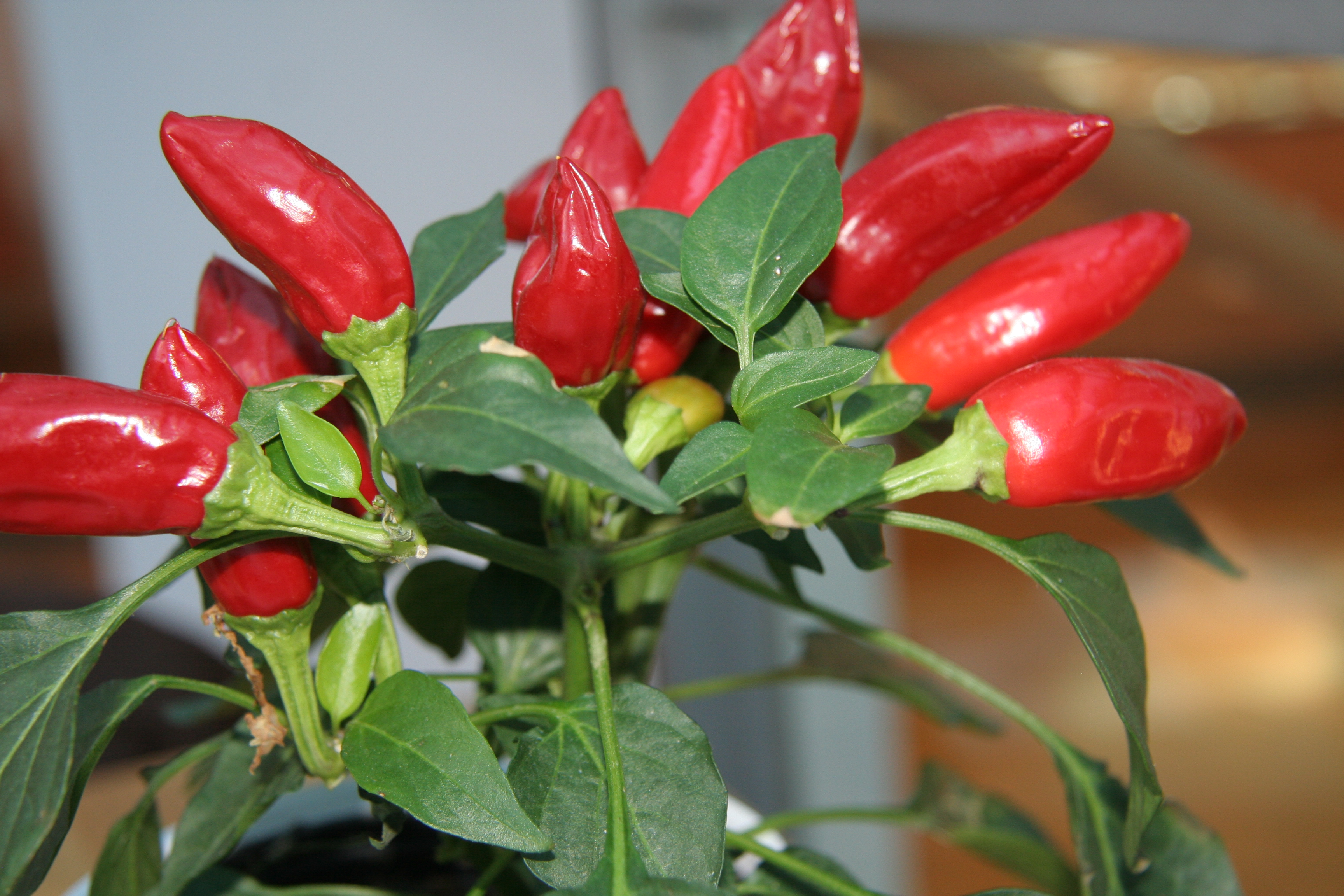
I have long since learned that if you want to cook with rare and exotic spices, and find some fresh produce from far and away places, the best way to do this is to shop at one of the many ethnic grocers around town. I blogged about this long ago when I was in search of greens and wrote “Finding Green Leafies in Denmark,” and listed a few places to find organic goods as well as some of the ethnic shops. I still have yet to find a place to source greens like kale, collard greens or mustard greens, however I now know where to go to find bok choy fairly easily.
The Danish website AOK just published a list of ethnic grocers on their website and it’s broken down by nation. So, if you are in search of fresh baby ginger, basil, lemongrass, and chili from Thailand, curry from India, reasonably priced tofu, legumes and grains from the Middle East like couscous and chick peas, or Japanese seaweed paper and parafanalia for home-made sushi, consult with the list to find what you need!
http://www.aok.dk/shopping/artikel/find-din-lokale-etniske-koebmand
Wonderful Words of Wisdom
Posted on April 27, 2010 1 Comment
This Easter I participated in a four-day yoga workshop at Hamsa Yoga Studio with American Iyengar teacher, Jack Davis (who is also opening a new studio in Frederiksberg called Yogacentralen in August). During the course, on Easter Sunday, Jack read the following quote from Paramahansa Yogananda, one of the first Indian yogis to bring yoga to the west, also known for his book Autobiography of a Yogi, a yoga literature classic. I thought it was a beautiful collection of words that encapsulated a wealth of meaning and poignancy, so I decided to put it up here to remember it.
Be always intoxicated with the Divine, with the wave of your consciousness ever at rest on the bosom of the Eternal Sea. When one is kicking and splashing about the water, there is little consciousness of the ocean itself, but of the struggle. But when one lets go and relaxes, the body floats; it feels in its buoyancy the whole sea lapping around it. That is the way the calm devotee feels God, with the whole universe of Divine Happiness rocking gently beneath his consciousness. ~From “The Yoga of Jesus: Understanding the Hidden Teachings of the Gospels”, Paramahansa Yogananda
 Laura Stadler Consulting